Qi Gong 气功
Qi (气) “flow,” and Gong (功) “work.”
Qi Gong can therefore be understood as working with this flow.
Through Qi Gong, the practitioner develops the fundamentals—and thus the conditions—that enable the practice of internal martial arts: alignment and opening of the body, breathwork, as well as grounding and rooting.
The training focuses on standing postures (站桩 Zhan Zhuang), fundamental repetitive movement forms, and fundamental Taoist breathing methods. The standing Qi Gong practice can also be understood as a form of standing meditation practice.
Wudang Tai Ji Quan 武当太极拳
The foundation of Tai Ji Quan forms the Qi Gong practice—like a river that arises from stillness and remains anchored in it, even as the steps change and the speed of movement may vary.
In this sense, Tai Ji Quan can be understood as a walking meditation practice.
The practice builds systematically and step by step. Beginning with still and standing exercises, through the development of fundamental stepwork and movement sequences, to connected forms, and eventually to combat application and partner work (推手Tuishou).
The form conveys specific individual exercises and serves as a vehicle for the practitioner to develop and maintain stillness in movement, to learn to act from a rooted, grounded, and at the same time permeable structure. The movements are initially slow and later follow different rhythms and dynamics.
Tuishou (Push Hands) 推手
Tuishou, also known as Pushing Hands, is a traditional partner practice in the internal martial arts, specifically Tai Ji Quan. Rather than relying on brute force, it explores how incoming forces are absorbed, redirected, and returned through alignment and the coordination of the entire body and mind.
The practice includes postural work, fundamental combat applications, and progressively structured partner exercises. Particular emphasis is placed on grounding, whole-body connection, and “listening” through contact. Tuishou is not a fight in the conventional sense, but rather a physical dialogue that reveals how we organize ourselves and relate to another.
Wudang Schwert (Jian) 武当 剑
The Sword practice is based on the same fundamentals as Tai Ji Quan and Tuishou, expanding upon them to include the handling of a weapon.
The sword reveals how the body is organized: any lack of clarity in posture, direction, or timing is immediately reflected in the movement of the blade. Practice involves set forms and drills in which footwork, body movement, and sword handling are integrated. The goal is not to move the sword in isolation, but to generate the movement from the entire body, extending to the tip of the blade and beyond.
The practice alternates between clearly guided sequences and freer forms of exercise, developing flexibility without building tension. Structure and relaxation remain interconnected throughout.
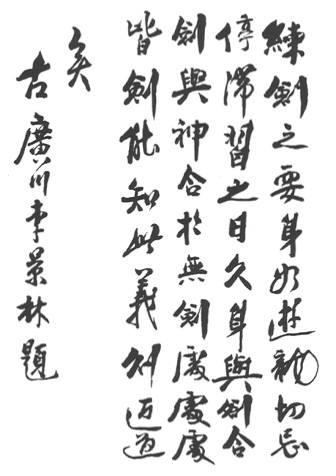
練剣之要身如遊龍切忌停滯習之日久身與剣合剣與神合於無剣處處處皆剣能知此義則近道矣右廣川李景林題
The key in sword practice is that your body moves like a swimming dragon, never coming to a halt.
After practicing over a long period, your body will unite with your sword,
then your sword will merge with your spirit.
There will be no sword anywhere, and everywhere there will be a sword.
When you are able to understand this principle, you are almost there.
– calligraphy by Li Jinglin of Guangchuan